
Seymour Directory Collections by Year
Seymour city directory research rests on three overlapping printed runs and a broader local shelf. The Indiana State Library Jackson County directory guide identifies individual Caron issues, countywide Haines books, and a Polk volume. A National Register bibliography separately cites a long run in the Indiana Room at Seymour Public Library. Those sources answer different questions. The State Library list confirms specific issues and call-number trails, while the bibliography shows the broader scope of the local collection.
| Directory set | Verified years | Research location | How to consult it |
|---|---|---|---|
| Caron's Seymour directories | Selected issues, 1922–24 through 2002 | Indiana State Library and Seymour Library | Reference shelf or microfilm; selected issues noted on Ancestry |
| Haines South Central Indiana | Countywide issues, 1988–2013 | Seymour Library and State Library holdings | Ask staff to verify the needed year and branch shelf |
| Polk Seymour–Jackson County | 2012 | State Library guide; local shelf status unconfirmed | Verify the physical volume before visiting |
| Indiana Room bibliography | 1901–1994 cited as a broad run | Seymour Public Library | In-person or reference-desk help; issue survival varies |
| Telephone and reverse material | Multiple runs; exact years not published | Seymour Library Local History/Genealogy | Ask for telephone, householder, reverse, or criss-cross sections |
The verified Caron list is not continuous. It includes paired editions and scattered single years, so a missing year in the guide should not be treated as proof that Seymour lacked a directory then. No official source identified one final printed-directory year. The latest named local items are Caron 2002, Polk 2012, and Haines through 2013. Confirm the edition before planning a visit, especially when the desired year appears only in the broad 1901–1994 bibliography.
Caron's Seymour City Directory Run
The issue-level Caron trail is unusually detailed. Listed editions include 1922–24, 1925–26, 1927–28, 1931–32, 1940–41, 1943–44, 1947, 1950, 1953, 1955, 1957, 1959, 1960, 1962–64, 1966–68, 1971, 1973–77, 1980, 1982–85, 1988, 1989, 1992, 1998, and 2002. The guide even gives call-number paths, including ISLI 910 S521CI for 1922–24 and ISLI 910 S521C 1940–41.
That run is ideal for tracking changes between census years. Search both sides of a suspected move, then write down the exact spelling, page, address, and every symbol printed beside the name. Selected 1922–24 and 1940–41 issues are noted as available through Ancestry, but access and image rights can vary. The physical or microfilm copy remains the sound fallback when a digital result is unavailable.
Note: A year absent from the State Library table may still survive locally, so ask staff before treating the gap as final.
Seymour Directory Help Upstairs
The Seymour Library Local History/Genealogy room is upstairs and can be reached at 812-522-3412 ext. 1240 or ref@myjclibrary.org. Bring a surname, street name, rough house number, and date window. Staff can help locate city and telephone directories, maps, atlases, plat books, school and church histories, newspapers, yearbooks, and Jackson County record microfilm.
Ask in the language librarians use. Request a "reverse," "criss-cross," "householder," or telephone section if the search begins with an address. No official inventory established which Seymour editions contain such a section. Check the addresses immediately above and below the target number because a house may be omitted, abbreviated, or indexed under a business.
The room also holds scattered newspaper runs from 1849 to the present, though no title-by-title coverage schedule was published. Give staff the directory year, exact spelling, and address when asking for a notice or clipping. That focused request is more useful than asking for everything about a surname, and it preserves the link between the printed entry and the later source.
Search Seymour Names in Legacy
Indiana Legacy supplies a free digital index beside the printed city directory shelf. Its advanced search accepts text, a second text term, match settings, dates or a date range, exact keywords, record type, and a named index. Options include marriage, newspaper, obituary, cemetery, school, military, biography, and yearbook material.
The captured Indiana Legacy screen shows why the index is useful after a directory find.
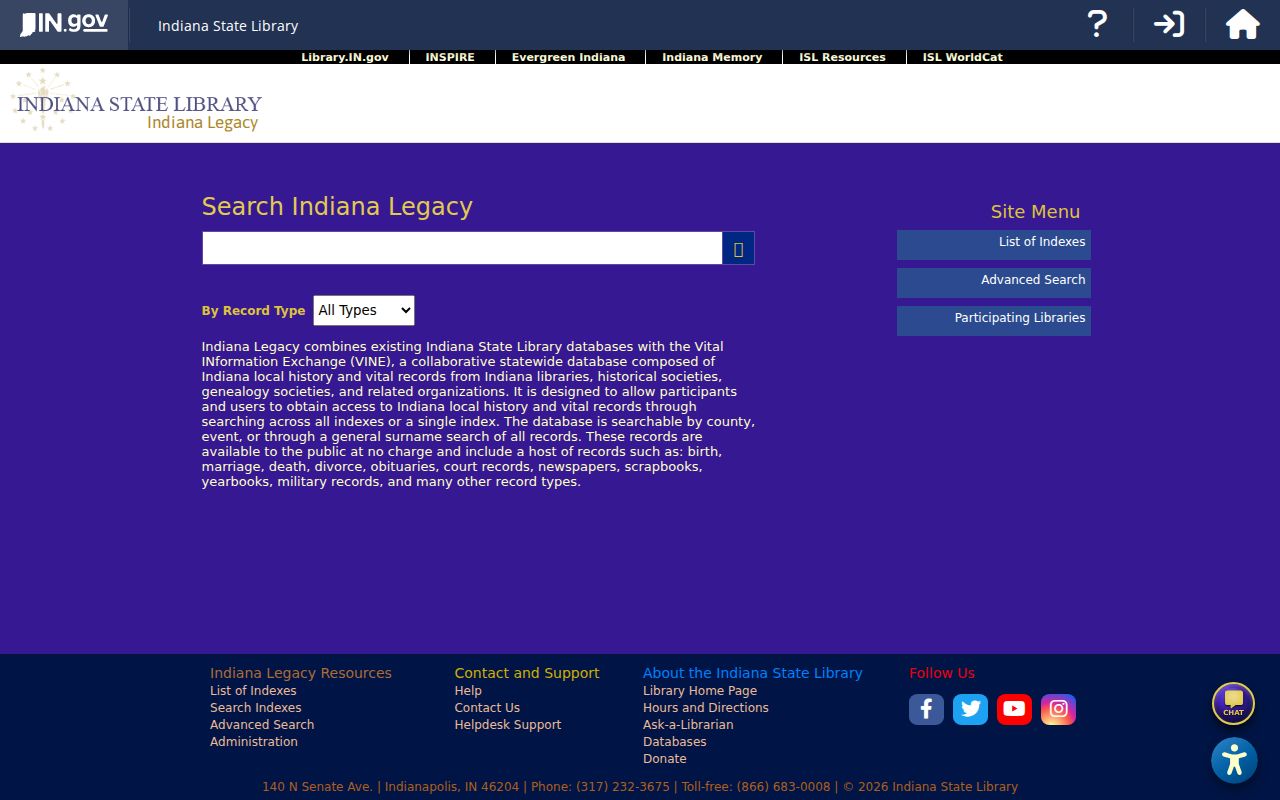
A surname plus Seymour, an address, a school, or a date range can connect the printed line to another indexed source. Legacy may show only an index entry, not the original image. Record the contributing library and collection name, then request the underlying item when proof matters.
Reading a Seymour Directory Entry
No stable public scan of an individual Seymour entry was captured in the research. That gap matters. The collection guides verify titles and years, but they do not prove that every edition printed the same fields. Photograph or transcribe the edition title, page, alphabetic or street section, exact spelling, address, notation, and abbreviation key before interpreting the line.
| Printed name | Copy surname, given name, initials, and spouse or relation marks exactly. |
|---|---|
| Work line | Capture any business or occupation text without assuming it appears in every edition. |
| Street line | Note house number, street spelling, suffix, and whether the entry points to a residence. |
| Status mark | Record owner, renter, widow, or similar notation only when the edition key defines it. |
| Phone or update | Keep any number, correction, crossed-out text, or handwritten change as a dated clue. |
- Criss-cross directory
- A section arranged by street and house number, allowing an address-first search rather than a name-first search.
- Householder index
- A list centered on the named person associated with a household; its scope depends on the publisher and edition.
- Abbreviation key
- The volume's own legend for shortened words and symbols. Copy it before decoding any entry.
A printed directory entry is a date-stamped clue, not a full household certificate. A spouse may be shown while children are not. A business can appear at an address without proving that its owner lived there. Compare the line with the next available edition and with a separate record.
Seymour Directories Meet Old Maps
Seymour's historical map shelf helps when an address changes or a building use is unclear. The documented Sanborn fire-insurance years are 1887, 1892, 1896, 1901, 1907, 1913, and 1924. Atlases from 1878 and 1900 add lot and place context. Sanborn sheets show footprints, materials, and commercial use, not a complete list of occupants.
The Commercial Historic District, Walnut Street houses, and Westover Addition represent different development eras. Pair the directory address with its lot, block, nearby cross street, and map date. If the street number fails, the County Surveyor's road maps, railroad plans, cemetery plats, and subdivision records may preserve an older geographic key. The National Register nomination provides the cited Sanborn and Seymour directory bibliography.
Jackson Microfilm Extends the Directory
The State Library's Jackson County microfilm inventory supplies the fallback when a name disappears from a book. It lists court records from 1816–1922, deeds from 1816–1888 with later 1891–1900 indexes, marriages from 1816–1951, naturalization from 1852–1905, probate and wills from 1818–1928, and delayed-birth material. Seymour Library also holds county-record reels.
A directory line cannot be certified by the library. The Jackson County Recorder certifies recorded instruments, the Clerk handles court and marriage files, and state or local vital-record custodians handle eligible certified copies. Use the library to locate the clue and the legal custodian to obtain the official record.
Seymour's Railroad Research Trail
The Indiana State Library county guide notes the first documented United States train robbery at Seymour in 1866. That event does not identify a modern resident, but it shows how local history can widen a city directory search. Railroad records, transportation maps, newspapers, business books, and biographies may explain an occupation or address abbreviation that means little by itself.
Jackson County History makes the 1886 county history searchable and points to 1905, 1976, township, and municipal histories. The site says most local city directories reach to about 1900 and also offers family, house, military, and local research guides. Treat a biographical sketch as a lead. Match it to the directory edition and original records.
Trace Family Through Seymour Directories
For family history, city directories fill the years between public census schedules. The federal census follows a 72-year release rule, and the latest public population census is 1950. A nearby directory issue can narrow the date of a move, marriage, death, or change in business, but disappearance alone does not explain what happened.
- Start with the closest verified Caron, Haines, or Polk year and copy the entry plus the edition key.
- Check the prior and next available issues. Track initials, spouse marks, address changes, phone changes, and business text.
- Inspect a reverse section when one exists, including the address numbers on both sides of the target.
- Pair the directory with the 1940 or 1950 census household, then test names in marriage, obituary, newspaper, and probate indexes.
- Use maps and deeds to confirm that the lot or building stayed the same when the street label changed.
A former classmate trail can also pair yearbooks with directories and Indiana Legacy. School, church, military, and civic sources provide context, but private rosters should never be assumed public. When a name vanishes, test several outcomes: the person moved, died, married under another surname, went unlisted, or fell into a missing edition. An obituary, deed, probate file, or later directory can separate those possibilities.